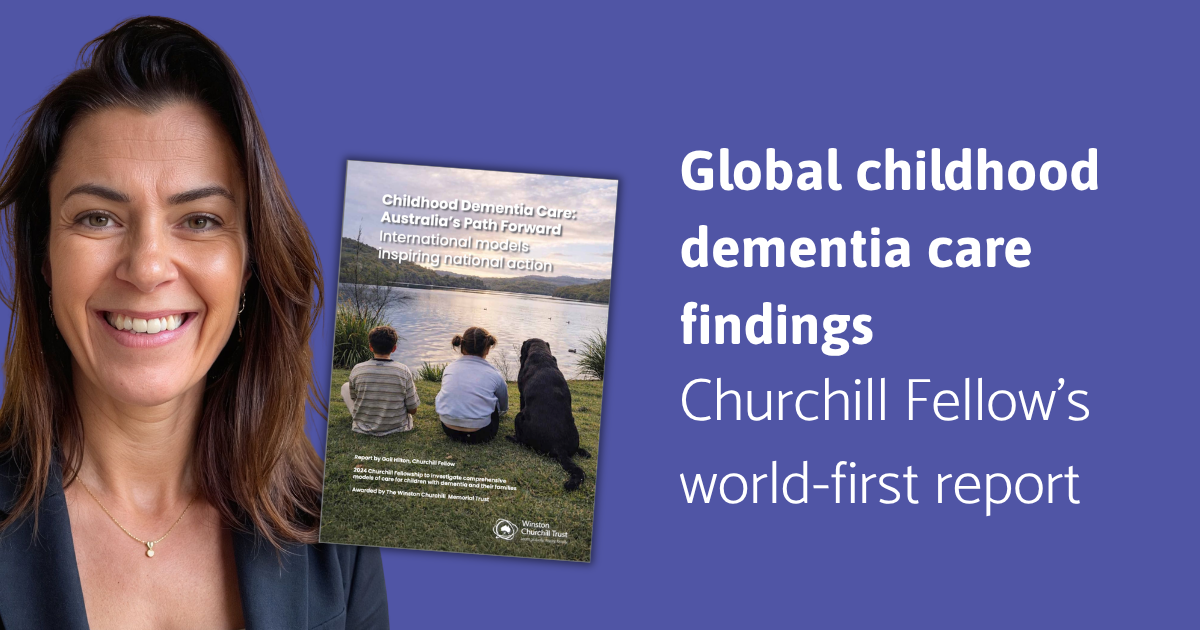
Churchill Fellow’s world-first report: findings on childhood dementia care globally
Jan 2026: A world-first global investigation into care for children with dementia has found that no country has yet developed a comprehensive national approach to childhood dementia and that Australia is uniquely positioned to lead.
The findings are published in Childhood Dementia Care: Australia’s Path Forward. International models inspiring national action, a report by Gail Hilton, Director of Programs at Childhood Dementia Initiative and 2024 Churchill Fellow. Awarded by the Winston Churchill Memorial Trust, the prestigious Churchill Fellowship took Gail across Norway, the United Kingdom, Canada, and the United States, where she visited specialist centres, multidisciplinary clinics, palliative care services, and patient organisations.
Gail engaged with more than 60 professionals and families with lived experience and is the first person to undertake a comprehensive global study of care approaches for children living with dementia.
“I’m honoured and very grateful to the Winston Churchill Memorial Trust for enabling this important work. The Trust’s recognition of the unique needs of children living with dementia, and the belief that this project could drive real change here in Australia, has enabled this world-first investigation that we can now use to benefit families now and into the future.”
Findings
There are no comprehensive models of care for childhood dementia, but there are examples of best practice:
- The most sophisticated care existed where professionals saw sufficient numbers of children to develop genuine expertise
- Norway’s Frambu Centre, Colorado’s neurodegenerative clinic, and disease-specific services in the UK demonstrated that concentrated exposure enables professionals to anticipate needs, develop innovative interventions, expedite research, and guide local teams
Families drive innovation:
- The most innovative services internationally owe their existence to parents who transformed personal experience into systematic advocacy
- This pattern demonstrates both extraordinary human resilience and profound systemic failure. Sustainable care cannot depend on exceptional individual efforts by families already managing devastating circumstances
Cross-system coordination is required:
- Childhood dementia care extends beyond health services, requiring integration across health, disability, education, and social support
- Even in countries with sophisticated healthcare systems, families become default coordinators navigating disconnected services
- The UK’s Child in Need legislation and Canada’s complex care model demonstrate structured approaches, though neither fully addresses cross-sector integration
Peer support is essential:
- Families across all countries — both those currently caring and those bereaved — identified connecting with others facing similar journeys as the most valuable support, often more valuable than medical interventions
- Yet healthcare systems consistently undervalue peer connection as supplementary rather than essential to comprehensive care
“Everywhere I looked, where real progress was being made, it was families leading the charge,” said Gail. “While that speaks to their incredible strength, it also reveals a serious systemic gap. Progress in this space cannot depend on how hard a parent can advocate. We must transition to a government and policy-led approach — one that takes that burden off families’ shoulders and places responsibility where it belongs.”
Australia’s moment
Australia is the first country in the world to recognise childhood dementia as a unified group of conditions — a collective approach pioneered by Childhood Dementia Initiative that is attracting significant global interest. The report’s findings strengthen the case for Australia to build the national infrastructure to match that ambition.
“Children living with dementia represent a truly unique cohort — one with complex, high-level needs that cut across multiple sectors of care,” said Gail. “What this fellowship reinforced for me is that we must build a specialist workforce that understands this cohort deeply and works collaboratively around each child and their family. This is not a group that can be well-served by a generalist approach.”
Read the full report: Childhood Dementia Care: Australia’s Path Forward. International models inspiring national action