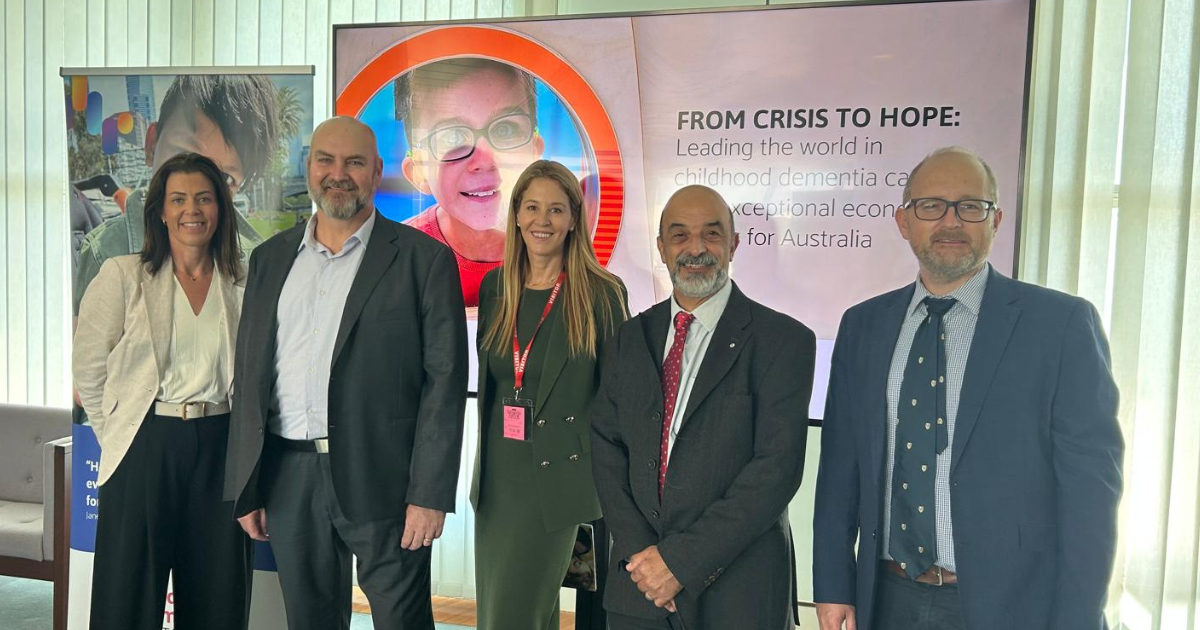
From left: Gail Hilton, Steve Lloyd, Megan Maack, Professor John Christodoulou and Dr Nick Smith.
Parliament urged to act on childhood dementia: Special briefing calls on government to fund national solution
March 2026: Parliamentarians have been urged to support a national solution to childhood dementia, as families, clinicians, and researchers united at Parliament House to make the case for urgent action.
Childhood Dementia Initiative hosted From Crisis to Hope: Leading the World in Childhood Dementia Care with Exceptional Economic Returns for Australia — a special briefing for representatives at Australia’s Parliament House in Canberra on 10 March 2026. Speakers and an expert panel examined the significant gaps and opportunities to improve care and support for children with dementia and their families. Childhood Dementia Initiative is calling for a proposed virtual centre of expertise, the National Childhood Dementia Unit, to be funded.
Earlier that day, CEO Megan Maack met with Prime Minister Anthony Albanese alongside Sarah and Brett, parents to Charlotte, who lives with childhood dementia, and her brother Finn. Charlotte’s family are constituents in the Prime Minister’s electorate of Grayndler. It was the second time Mr Albanese had met with Charlotte’s family and Megan, having previously met them in 2024. The meeting was an opportunity to highlight to the Prime Minister the impacts of childhood dementia and update him on the outcomes of Australian Government-funded research into how care for children with dementia can be transformed.
“We are aware the Prime Minister had been up since the early hours of the morning managing world events, and yet he still took the time to meet with us and hear about childhood dementia,” said Megan Maack, CEO of Childhood Dementia Initiative. “That means a great deal to families like Charlotte’s.”
The National Childhood Dementia Unit would establish Australia’s first nationally coordinated approach to care for children with dementia — a condition that causes a child’s death every 4 days in Australia, yet remains without a coordinated national response. The Unit would comprise 4 integrated components:
- Model of Care. Sets nationally consistent standards of care for children with dementia.
- National Reference Centre. Gives health professionals access to expertise & resources to enable the delivery of quality care.
- Therapy Access Hub. Identifies and facilitates access to potentially life-saving emerging therapies and clinical trials.
- Patient Data Solution. Makes children with dementia visible in our health system for the first time through national data collection.
Conservative economic analysis shows that a $12.6 million investment would return $61.5 million in quantified benefits over 5 years.
“We have the evidence. We have the solution. For the first time, we have everything we need to act. All that remains is the decision to do so," said Megan in her address to the room.
Steve Lloyd, father to 2 boys living with childhood dementia, said: “We're coming from a very dark place. Six years ago, an event like this probably wouldn't happen. This is the second time I've been to Parliament for opportunities like today. And so I guess, some of those little cracks of sunlight coming into a very dark world mean that there is some hope at the end of the tunnel.”
Watch the parliamentary briefing
The event was convened by the Parliamentary Friends of Early Childhood, co-chaired by Senator Marielle Smith. The expert panel brought together:
- Professor John Christodoulou AM, a leading medical geneticist at Murdoch Children’s Research Institute and pioneer in the diagnosis and treatment of conditions that cause childhood dementia
- Gail Hilton, Director of Programs at Childhood Dementia Initiative and 2024 Churchill Fellow, whose global investigation of childhood dementia care models has informed the case for a national approach
- Steve Lloyd, father to Ethan and Ronin who both have childhood dementia
- Dr Nicholas Smith, a neurometabolic neurologist with over 20 years of experience spanning patient care, clinical trials, and research in Australia, the UK, and the US
“We are deeply grateful to Senator Marielle Smith and the Parliamentary Friends of Early Childhood for convening this briefing, to our expert panel for lending their voices and expertise, and to everyone who attended and engaged so thoughtfully on the issues and opportunities raised,” said Megan Maack. “Together, we are building the momentum that will turn hope into action for children with dementia and their families.”
Read the report and download the briefing paper.
Background
Childhood dementia is caused by more than 100 genetic conditions and affects 1 in every 2,900 babies born in Australia — a rate comparable to cystic fibrosis. Half of all children diagnosed will die before their 10th birthday. Annually, childhood dementia causes 91 deaths in Australia. Childhood cancer causes 92 deaths in children aged 0-14. Yet unlike childhood cancer, there has been no improvement in survivorship for children with dementia.
Prior to the founding of Childhood Dementia Initiative in 2020, the conditions that cause childhood dementia were largely considered in isolation from one another, each treated as a separate rare disease rather than as a collective.
Over the following 5 years, Childhood Dementia Initiative and researchers investigated the gaps in care and support for children with dementia. Research, undertaken with support from the Australian Government, incorporated lived experience, data, and expert input and uncovered deeply concerning findings across 5 areas:
- Diagnostic delays and lack of expertise and access to information among health professionals
- No national consistency in the care given to children, resulting in fragmented, crisis-driven, reactive care
- Limited access to emerging therapies and clinical trials
- Children are unidentifiable in health system data
- Families bear an impossible burden, left to research treatments, coordinate care and educate providers independently
With additional funding from the Australian Government, a 2-year project was undertaken to design a solution. Working with international management consultancy Nous Group, Childhood Dementia Initiative engaged stakeholders — including families and health professionals — across more than 40 focus groups and interviews. Organisations from beyond the childhood dementia field also contributed, including the McGrath Foundation, Canteen, and the National Eating Disorders Collaboration. The outcomes of that project were the detailed report, National Childhood Dementia Unit (NCDU) Business Case, and the summary report, From Crisis to Hope: Leading the World in Childhood Dementia Care with Exceptional Economic Returns for Australia.
Australia is the first country in the world to consider the collective group of childhood dementia conditions in a system-wide approach, and the first to recognise children as a priority population in national dementia policy.