Home > Families & Carers > Family Guide > Understanding Paediatric Palliative Care: A guide for grandparents, family and close friends
Understanding Paediatric Palliative Care: A guide for grandparents, family and close friends of children with childhood dementia conditions
A guide that explains paediatric palliative care in simple terms and provides practical ways to support a family.
Is this resource helpful?
Summary
Learn about:
- What paediatric palliative care is and what it means for the family
- How palliative care helps children and families
- Practical and emotional ways to support the family
- How to provide long-term support
- How do I know when to visit and when to give space?
- Should I bring up the child's condition or pretend everything is normal?
- What if I'm struggling with my own emotions about the child's condition?
- How can I help the siblings?
- What if the family's decisions don't make sense to me?
- What if I don't know what palliative care involves?
If your family is impacted by childhood dementia, we invite you to receive updates and learn about ways to connect with Childhood Dementia Initiative and with other families.
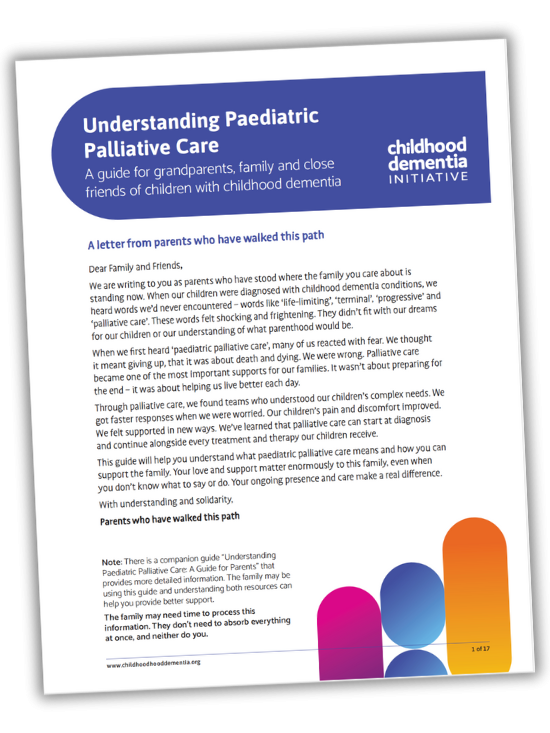
A LETTER FROM PARENTS WHO HAVE WALKED THIS PATH
Dear family and friends,
We are writing to you as parents who have stood where the family you care about is standing now. When our children were diagnosed with childhood dementia conditions, we heard words we’d never encountered – words like ‘life-limiting’, ‘terminal’, ‘progressive’ and ‘palliative care’. These words felt shocking and frightening. They didn’t fit with our dreams for our children or our understanding of what parenthood would be.
When we first heard ‘paediatric palliative care’, many of us reacted with fear. We thought it meant giving up, that it was about death and dying. We were wrong. Palliative care became one of the most important supports for our families. It wasn’t about preparing for the end – it was about helping us live better each day.
Through palliative care, we found teams who understood our children’s complex needs. We got faster responses when we were worried. Our children’s pain and discomfort improved. We felt supported in new ways. We’ve learned that palliative care can start at diagnosis and continue alongside every treatment and therapy our children receive.
This guide will help you understand what paediatric palliative care means and how you can support the family. Your love and support matter enormously to this family, even when you don’t know what to say or do. Your ongoing presence and care make a real difference.
With understanding and solidarity,
Parents who have walked this path
UNDERSTANDING PALLIATIVE CARE
We understand you’re supporting someone close to you to navigate one of the most challenging experiences any family can face. If you’ve heard the term ‘paediatric palliative care’ mentioned in relation to a child in your family, you may feel confused, frightened, or uncertain about what it means.
These reactions are natural and shared by many grandparents, family members, and friends who first encounter this term. This guide has been created to help you understand what paediatric palliative care really means – not as something to fear, but as a form of support designed to improve the child’s comfort and the family’s quality of life. You don’t need to read everything now. Take your time, return to sections when you’re ready, and know that understanding these services is one important way you can support the family you care about.
The paediatric palliative approach
The most important thing to understand is that paediatric palliative care is NOT about giving up on the child or preparing for the end of life. It is about improving quality of life from diagnosis onwards.
What is the palliative approach?
The paediatric palliative approach is a way of thinking about care that focuses on:
- The child as a whole person – not just their medical condition
- Quality of life for the child and entire family
- Managing symptoms that affect the child’s comfort and wellbeing
- Supporting the family through the challenges they face
- Honouring the family’s values and what matters most to them
- Working alongside all other treatments and therapies
This approach recognises that:
- Whilst the child has a life-limiting condition, they are living today
- Every day matters and should be as good as possible
- The family’s needs are unique and important
- Parents know their child best
Important: Many healthcare professionals use this approach in their care without calling it ‘palliative care’. The family might already be receiving palliative care approaches through the child’s current medical team.
The World Health Organisation definition
The World Health Organisation defines palliative care for children as:
The active total care of the child’s body, mind and spirit, and also involves giving support to the family
It begins when a condition is diagnosed, and continues regardless of whether or not a child receives treatment directed at the condition
It can be provided in hospitals, community health centres and even in children’s homes
Key points to understand:
- It can begin at any stage of the child’s condition, even at diagnosis
- It works alongside medical treatments aimed at managing the child’s condition
- Palliative care is based on need, not prognosis – it’s best to start early
- It includes physical, emotional, social and spiritual care for the whole family
A paediatric palliative care service is a specialised team of healthcare professionals who provide the palliative approach to care. They work alongside the child’s existing medical team.
Important: Not every healthcare professional uses the palliative approach. Paediatric palliative care services are specially trained to provide this type of comprehensive, family-centred care.
What makes paediatric palliative care different?
Paediatric palliative care is different from adult palliative care and different from standard medical care:
- It’s designed specifically for children and families, understanding that children’s needs change as they grow
- It focuses on the whole family, not just the patient
- It can continue for months or years, not just weeks
- It works with uncertainty – many childhood conditions don’t have predictable timelines
- It supports normal childhood experiences alongside medical care
- It often provides priority access to other services when needed
PAEDIATRIC PALLIATIVE CARE AND THE FAMILY
Real parent experiences: why paediatric palliative care made a difference
“Information is choice and information is power, and now I feel informed.” – Parent
Before we explain what palliative care is, here’s what parents who have been through this journey want you to know:
It’s not about giving up – it’s about quality of life
“Hannah is not actually sick…but it’s about quality of life. We need someone to help us with all these symptoms, which is the quality of life stuff.” – Rachel
Priority access when you need it most
“Once we were in palliative care… things move very quickly, and not because it’s the end of life. It’s because it’s a priority. They know it’s important… You don’t want your kid to spend a lot of time in hospital so you can go home quickly, or they can see your child quicker. It’s good for your mental health and also for your kid.” – Ana
Access to better symptom management
“I was always asking for medicine for Philip, because he was vomiting all the time, at least 8 times a day… they said, ‘No, we cannot give you anything’ until he went to palliative care at the end, and they said, ‘we can give the medicine we give to people with terminal cancer’… and he didn’t vomit. And it made the difference… I could see he was not suffering.” – Ana
Early connection builds important relationships
“We were referred to palliative care quite early on…. it was really positive to have a relationship with palliative care that preceded Mia getting really sick… it was really helpful for our family to have that pre-existing relationship and familiarity with the staff, before we were in very vulnerable personal space.” – Peta
Flexible approach to trying different things
“Having that sort of more flexible approach, and a relaxed approach to trying different things was really helpful… if it’s good for the child, let’s try it.” – Amy
The family might already be receiving palliative care
The family may already be receiving palliative care approaches through their current medical team without it being called ‘palliative care’. If the child’s doctors are focusing on comfort, quality of life and supporting the whole family – that’s the palliative approach, even if it’s not formally named.
This is important to understand because:
- The family may not realise they’re already benefiting from palliative approaches
- Formal palliative care services may provide additional specialised support
- Understanding this helps you better support the family’s care decisions
How paediatric palliative care helps families
For the Child:
Better symptom management:
- Improved pain relief from pain experts
- Help with seizures, breathing difficulties, nausea, sleep problems
- Medication reviews and management
- Access to specialists who understand complex symptoms
- Faster access to all these things listed
Improved comfort and quality of life:
- Focus on what makes the child comfortable and happy
- Support for activities they enjoy
- Maintaining their relationships and interests
- Advocacy for their needs in all settings
Age-appropriate support:
- Communication that matches the child’s understanding
- Play therapy, music therapy and other specialised allied health services
- Support for normal childhood experiences
- Respect for their personality and preferences
For the parents:
Help navigating complex systems:
- Someone who understands the healthcare maze
- Coordination between different specialists
- Advocacy when they feel overwhelmed
- Clear communication about their child’s care
Priority access:
- Faster responses when they need help
- Direct contact numbers for urgent concerns
- Recognition that their child’s needs are complex
- Less time waiting in emergency departments
Emotional and practical support:
- Understanding of what they’re going through
- Help with difficult decisions
- Respite care options
- Connection with other families
Planning support:
- Help thinking about future needs
- Assistance with advance care planning when they’re ready
- Support for the decisions that matter to their family
- Coordination of equipment and services
For siblings:
Age-appropriate support:
- Help understanding what’s happening to their sibling
- Counselling and emotional support
- Normal childhood activities and experiences
- Connection with other children in similar situations
Family support:
- Recognition that the whole family is affected
- Help maintaining sibling relationships
- Support for their own grief and worries
- Respite activities and fun experiences
For extended family (including you):
Information and support:
- Help understanding the child’s condition
- Guidance on how to support the family
- Connection to other families
- Resources for grandparents and other relatives
Practical benefits that made a real difference
Understanding these specific benefits helps you appreciate why palliative care matters to the family:
Better symptom control
“We had those days where Louis would cry for six, seven hours straight… you’re allowed to say things like his medications need review. You’re allowed to prompt things.”
Priority status
“Once we were in palliative care… you are a priority. I’m going to call a doctor right now to see your son. I might give you a private room.”
Peace of mind
Knowing there’s a team available who understands the child has a life-limiting condition provides families with crucial support.
Flexible approach
“Having that sort of more flexible approach, and a relaxed approach to trying different things was really helpful… if it’s good for the child, let’s try it.”
COMMON CONCERNS AND HOW TO RESPOND
Does this mean they’re giving up hope?
No. Palliative care works alongside treatments and can continue for months or years. It’s about adding support, not removing hope. Many families receive palliative care while still pursuing treatments.
Hope can take many forms:
- Hope for comfort and reduced suffering
- Hope for quality time together
- Hope for the child to experience joy
- Hope for better symptom management
- Hope for meaningful experiences and memories
- Hope for research and new treatments
How you can support hope in the family:
- Focus on present joys and experiences
- Help create meaningful memories
- Support the family in pursuing quality of life goals
- Never tell them to “stay positive” – acknowledge their reality while supporting their hopes
- Remember that hope takes many forms and changes over time
Is this only for when the child is dying?
No. Palliative care is appropriate for any child with a life-limiting condition. It can help throughout the child’s journey, not just at the end. Many children receive palliative care support for years while living full lives.
Will this upset the parents if I ask about it?
It’s natural to have questions. You can ask the parents what palliative care means for their family and how you can best support them. Follow their lead on what they’re comfortable discussing. Many parents actually appreciate when family members and friends take the time to understand.
WHAT THIS MEANS FOR YOUR ROLE AS FAMILY/FRIENDS
Understanding the impact on parents
When a child has childhood dementia, parents often become what one parent described as the ‘operations manager’ for their child’s care. They may:
- Coordinate multiple medical appointments
- Manage complex medication schedules
- Navigate different healthcare and support systems
- Advocate constantly for their child’s needs
- Experience extreme emotional and physical exhaustion
Their grief is real and valid. They are likely to be grieving each and every day:
- The future they imagined for their child
- Lost abilities and milestones
- The impact on their family
- Their own sense of helplessness
Why parents may seem overwhelmed about accessing services
Based on parent experiences, families often face challenges accessing palliative care services:
The reality:
- Services don’t always reach out automatically – parents may need to follow up repeatedly on referrals
- Wait times can be lengthy – creating urgency and stress
- Coordination falls to parents – they become the ‘information hub’ for all medical professionals
- Parents must advocate strongly – as one parent shared:
This isn’t fair, but it’s often reality. Understanding this helps you appreciate why parents may seem stressed about appointments, referrals and accessing support services.
How you can help:
- Offer to make follow-up calls on referrals
- Help track appointments and timelines
- Understand why parents might seem stressed about administrative tasks
- Never judge if they seem ‘pushy’ with medical teams – advocacy is essential
- Offer to attend appointments to take notes or provide support
- Just be there to listen when they need you
- Think about what you can take off their plate: shopping, cooking, cleaning, etc.
How you can support the family
Practical support:
- Offer specific help rather than saying “let me know if you need anything”
- Help with siblings – school pickup, activities, normal childhood experiences
- Meal preparation (in containers that don’t need returning)
- Household tasks like cleaning, laundry or gardening
- Pet care or grocery shopping
- Transport for appointments or other children
Emotional support:
- Ask about the child specifically
- Don’t be afraid to ask how they’re going or what they’ve been up to
- Listen without trying to ‘fix’ things
- Continue to include them in family gatherings and normal activities
- Understand that they may need to cancel plans at short notice
- Don’t take it personally if they seem distant or overwhelmed
- Remember important dates and check in regularly
Supporting the child:
- Treat them with the same love and attention you always have
- Include them in age-appropriate activities when possible
- Don’t forget their siblings – they need attention too
- Follow the parents’ lead on what activities are suitable
- Remember their personality and interests beyond their condition
What NOT to say or do
Avoid saying:
- “Everything happens for a reason”
- “God only gives special children to special parents”
- “At least you have other children”
- “I couldn’t do what you’re doing”
- “Have you tried [alternative treatment]?”
Avoid:
- Disappearing because you don’t know what to say
- Only talking about the illness when you visit
- Giving any form of unsolicited advice
- Making the family feel like they need to take care of your emotions
- Visiting when you’re unwell or have been exposed to sickness (ordinary illnesses can pose significant risks for children receiving palliative care and it is best not to take chances)
What TO say and do
Helpful things to say:
- “I’m thinking of you”
- “I love you and I’m here for you”
- “What would be most helpful right now?”
- “Would it help if I [specific offer]?”
- “How is [child’s name] going?”
- “What has [child’s name] been enjoying lately?”
- Share positive memories of the child
- “I don’t understand what you’re going through, but I want to support you”
Helpful actions:
- Continue regular contact (texts, calls, visits as appropriate)
- Include the family in normal activities when possible
- Offer to coordinate help from other family and friends
- Learn about the child’s condition so parents don’t always have to explain
- Adjust your plans – if they can’t leave home, bring the party to them, remembering to check with the family first
Supporting the whole family unit
Understanding family dynamics
Childhood dementia affects everyone in the family:
Siblings may:
- Feel left out or forgotten
- Worry they might get sick too
- Feel guilty about being healthy
- Act out or regress behaviourally
- Need extra attention and reassurance
Grandparents often experience:
- Double grief – for their grandchild and for watching their own child suffer
- Feeling helpless to fix the situation
- Changes in their relationship with their adult child
- Financial and practical pressures from helping
Extended family may:
- Not know how to help
- Feel uncomfortable
- Gradually withdraw over time
- Struggle with their own grief and fear
May not realise it takes courage for families to actually ask for help. They might also not reach out again.
Long-term support
One of the biggest challenges families face is that initial support often fades over time. Some parents described an initial period of proactive support from their network, however as their child’s life extended and care needs increased, this natural support network waned, leaving them extremely isolated and socially disconnected.
How to provide lasting support:
- Understand this is often a long journey, not a short crisis
- Check in regularly, not just during medical crises
- Continue invitations to family events
- Remember birthdays and special occasions
- Be patient if they need to decline invitations
- Understand their energy and availability will vary
- Don’t stop asking – if they say no once, you can ask again later
WHEN THE CHILD IS RECEIVING PALLIATIVE CARE
What to expect
If the child is referred to palliative care services, this typically means:
- A specialised team will work with the family’s existing doctors
- There will be more support for pain and symptom management
- The family may have help with care coordination
- Emotional and spiritual support will be available
- The focus will be on quality of life and family wishes
- The family may get priority access to services and faster responses
How you can help
Respect the family’s decisions:
- Trust that parents are making the best choices for their child
- Support their care decisions even if you don’t fully understand them
- Avoid second-guessing their medical choices
Continue being family:
- The child is still your grandchild/niece/nephew/ friend’s child
- They need love, laughter and normal family interactions
- Create positive memories and experiences when possible
- Take photos and videos (with parents’ permission), these will be precious
Support advance care planning:
- Understand that families may need to make difficult decisions
- Respect their privacy around these decisions
- Offer emotional support without trying to influence choices
- Help them focus on what matters most to their family
Understanding the practical challenges
The coordination burden
Families often struggle with:
- Coordinating between multiple specialists who don’t always communicate with each other
- Managing complex medication schedules
- Following up on referrals that may not happen automatically
- Becoming the information hub for all medical professionals
How this affects family life
- Appointments may be cancelled at short notice due to the child’s condition
- Plans may need to change quickly based on medical needs
- Parents may seem overwhelmed by the administrative burden
- Decision-making can be exhausting when there are multiple specialists involved
Understanding these challenges helps you provide more targeted support and patience.
CREATING MEANINGFUL MOMENTS
One of the most valuable ways you can support the family is helping create and capture positive experiences.
Practical ways to help
- Offer to accompany the family on outings when the child is feeling well
- Help plan and carry out items from the child’s ‘life list’ or ‘bucket list’
- Take photos and videos during family gatherings (with permission)
- Create memory books or journals
- Support siblings in creating special moments with their sibling
Remember that small moments matter as much as big events – a quiet afternoon together can be just as meaningful as a major outing.
If you can, learn how to provide care for the child. Offer to be a back up so they can take a break or attend a meaningful event. Give them peace of mind by showing you could step in if they had an emergency.
FREQUENTLY ASKED QUESTIONS
How do I know when to visit and when to give space?
Ask the parents directly. Something like “Would a visit be helpful this week, or would you prefer we check in later?” Let them guide you.
Should I bring up the child’s condition or pretend everything is normal?
Follow the family’s lead. Some days they may want to focus on normal activities, other days they may need to talk about medical concerns. Be flexible.
Don’t be afraid to ask about the child specifically – many parents appreciate when people show genuine interest.
What if I’m struggling with my own emotions about the child’s condition?
It’s normal to grieve and feel overwhelmed. Seek your own support from counsellors, support groups, or other family members. Don’t rely on the child’s parents to support your emotions.
How can I help the siblings?
Offer to take them for normal activities, listen to their concerns, remember their birthdays and achievements, and help maintain their routines and friendships.
What if the family’s decisions don’t make sense to me?
Trust that parents know their child best. You don’t need to understand every decision, but you can still offer love and support.
What if I don’t know what palliative care involves?
It’s okay to ask questions or do your own research. Understanding what the family is going through helps you provide better support.
SUPPORTING YOURSELF
Supporting yourself
Watching a child you love live with childhood dementia is heartbreaking. It’s important to:
- Acknowledge your own grief and fear
- Seek support from friends, counsellors or support groups
- Take care of your physical and emotional health
- Remember that supporting the family is a marathon, not a sprint
- Find ways to honour your relationship with the child
- Set boundaries when you need to, while still offering support
Remember…
Your love and support matter enormously to this family. Even when you don’t know what to say or do, your presence and care truly make a difference.
Childhood dementia is a journey that no family should face alone.
The most important things you can do are:
- Stay connected over the long term
- Offer practical, specific help
- Follow the family’s lead
- Continue to see the child as a whole person, not just their illness
- Support the entire family unit
- Take care of yourself so you can continue to support them
- Ask about the child and show genuine interest in their life
- Don’t disappear because you don’t know what to say
A message about ongoing support
As one parent noted about people asking about their child:
“I love when people ask me about Philip… because it is very special. It makes me feel as a mum, like they still care, that Philip is still loved… People don’t ask me because they don’t want to hurt me. But it hurts more when you see everyone pretend nothing happens.” - Ana
Your interest and care matter more than having perfect words.
You are supporting a family doing an incredible job in impossible circumstances. They don’t have to carry this alone, and neither do you.
RESOURCES FOR FAMILY AND FRIENDS
For understanding childhood dementia:
For supporting families
- Understanding Childhood Dementia – A Guide for Grandparents, Families and Close Friends
- Local family support services
- Grief and bereavement counselling services
- Palliative Care Australia
- Paediatric Palliative Care Australia and New Zealand
For your own support
- Local counselling services
- Grandparent support groups
- Online support communities for extended family
- Your GP for referrals to appropriate support
- Lifeline: 13 11 14 (24-hour crisis support)
- Beyond Blue: 1300 22 4636
Understanding different services
- Hospital-based teams that work within children’s hospitals
- Community services that provide support at home
- Children’s hospices (like Bear Cottage in NSW, Very Special Kids in VIC, Hummingbird House in QLD) that offer respite and specialised care
- Specialised equipment and medication services. Understanding what services are available helps you better support the family’s needs.
Connect and stay up to date
If your family is impacted by childhood dementia, we invite you to receive updates and learn about ways to connect with Childhood Dementia Initiative and with other families.