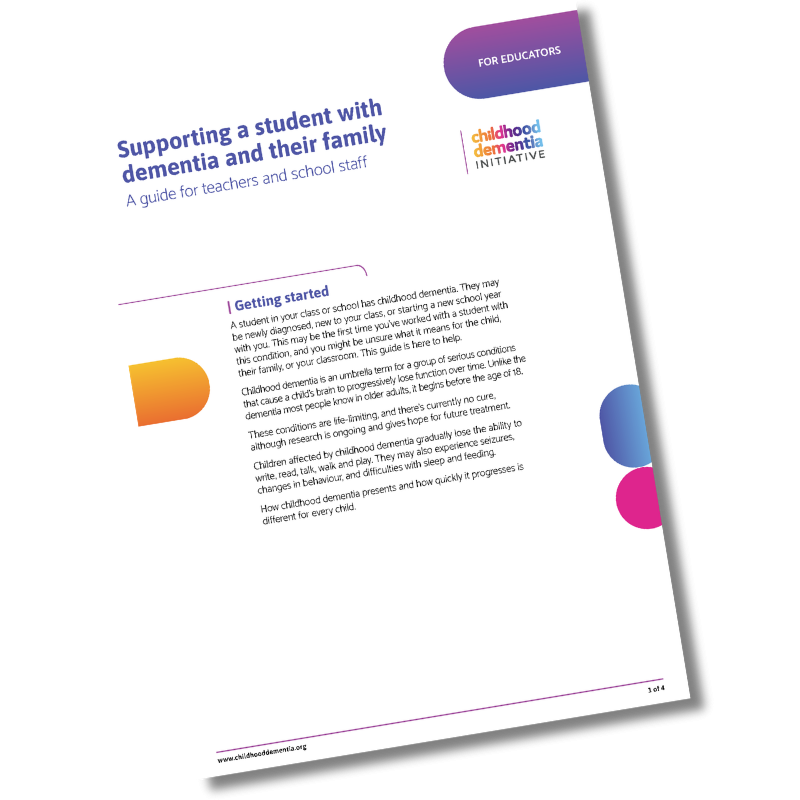
Supporting a student with dementia and their family
A guide for teachers and school staff
Is this resource helpful?
Summary
This guide gives a clear, straightforward explanation of supporting a student with dementia and their family. This resource features:
Getting started
A student in your class or school has childhood dementia. They may be newly diagnosed, new to your class, or starting a new school year with you. This may be the first time you’ve worked with a student with this condition. You might be unsure what it means for the child, their family, or your classroom. This guide is here to help.
Childhood dementia is an umbrella term for a group of serious conditions that cause a child’s brain to progressively lose function over time. Unlike the dementia most people know in older adults, it begins before the age of 18.
These conditions are life-limiting, and there’s currently no cure, although research is ongoing and gives hope for future treatment.
Children affected by childhood dementia gradually lose the ability to write, read, talk, walk, and play. They may also experience seizures, changes in behaviour, and difficulties with sleep and feeding.
How childhood dementia presents and how quickly it progresses is different for every child.
What this means in the classroom
Each child’s experience with dementia is unique. Progression varies widely between conditions, and even between children with the same condition. Skills your student has today may change over time. You might notice:
Cognitive changes
- Memory difficulties
- Problems with learning and understanding
- Difficulty communicating
- Reduced attention and concentration
Physical changes
- Changes in mobility or coordination
- Seizures (in some conditions)
- Vision or hearing loss (in some conditions)
- Fatigue
Behavioural and emotional changes
- Personality changes
- Disrupted sleep affecting their day at school
- Difficulty with social interactions
- Emotional disturbances such as anxiety and fear
What the family is going through
When a child is diagnosed with dementia, the entire family experiences significant changes. Understanding this helps you connect well from the start.
- Parents have become advocates, medical coordinators, and full-time carers while processing their own grief, including grief about what’s ahead. (This is known as anticipatory grief.)
- Siblings may feel confused or worried, may receive less attention, and can take on a young carer role at home.
- Daily life is filled with appointments, research, and adapting to changing needs.
- The future suddenly feels uncertain and requires new planning.
Some families have more than one child with childhood dementia. Because the conditions are genetic, siblings can have the same diagnosis. If this is the case, the family will be carrying even more.
Navigating healthcare, disability and education systems requires a lot from families. A welcoming and well-prepared classroom can make a real difference.
How you can support the student and family
Families impacted by childhood dementia have shared 5 requests of the professionals working with them and their child.
1. Treat the family with respect, care, and kindness
Take the time to listen, check your understanding, and follow through on what you say you’ll do. Asking how the whole family is going at the start of a conversation helps parents feel understood.
2. Acknowledge that parents are the experts on their child
Parents live with their child’s condition every day. They know how their child communicates, learns, and what works for them. Bring them in as partners.
3. Do some research to understand more about childhood dementia
Families don’t expect you to know everything. A willingness to learn about the child’s condition, and to be honest about what you don’t know, goes a long way.
4. Be ready to adjust as the child’s abilities change
Focus on what the child can still do. When something becomes harder, adjust your approach so the child can keep learning, connecting, and taking part.
5. Recognise the impact on the whole family
Childhood dementia affects the whole family, not just the student in your class. Siblings at the school may be carrying more than their peers, and parents are dealing with far more than what you see. A little awareness of what the family is holding goes a long way.
One parent described how their child was struggling to settle into school. They showed changed behaviour that staff hadn’t seen before, and found the classroom overwhelming. The teacher worked with the child individually. This meant taking them out of the classroom when needed, and adjusting activities to suit what they could manage that day.
Within 2 months, the child went from resisting school to asking to go every day.
“They changed things for him to make him happy, rather than making him fit into a box – they fitted the box around him.”
Preparing for your first meeting
A small amount of preparation can go a long way. Before you meet with the family for the first time:
- Spend a few minutes learning about their child’s condition: this shows the family you take their child seriously.
- Read any information the family has already shared with the school, so they don’t have to start from scratch.
- Come with questions rather than expecting them to lead. “What’s the best way for me to support your child in the classroom?” could be a good place to start.
- Ask about their communication preferences: how often, in what format, and with whom.
- Bring a colleague who will also be involved, so the family doesn’t repeat themselves later.
Working with the wider team
The child’s care during the school day can involve many people beyond their parents. This may include allied health professionals, classroom aides, specialists, and other school staff. Continuity matters, and so does consistent, clear communication.
- Build a shared picture: keep notes that other staff this year, and next year’s teacher, can pick up. The family shouldn’t have to start over with each new person.
- Agree on a point of contact: families value having someone in the school they can speak to consistently.
- Share information across staff who interact with the student, with the family’s consent.
- Stay in touch with allied health when they’re involved. Small adjustments in the classroom can support the work being done with the child outside the classroom.
The importance of hope
Hope matters for the student, the family, and you. Focusing on what’s possible, not only on what’s changing, can make a real difference to everyone. Children with dementia continue to experience joy, connection, and meaningful learning.
In practice, this looks like:
- Celebrating milestones and achievements of all sizes
- Helping the student maintain friendships and connection with classmates
- Including the student in class life: photos, birthdays, achievements, and milestones
“Despite the challenges, we're committed to giving our child the best possible life."
Looking after yourself
Supporting a student with a progressive condition can be emotionally challenging. You are part of a team, not on your own.
- Acknowledge your own feelings: grief, sadness, and uncertainty are valid responses.
- Talk to colleagues: share what you’re learning with other staff who interact with the student.
- Use your school’s wellbeing supports.
- Be patient with yourself: this is a learning process for everyone.
Resources and support
| For more information | For families | Additional support |
|---|---|---|
| Childhood Dementia Initiative Visit our page for professionals |
Childhood Dementia Initiative Visit our page for families |
Beyond Blue: 1300 22 4636 Lifeline: 13 11 14 |
This guide is intended as general information about childhood dementia. For specific information about a student’s medical condition, please consult their family or a healthcare professional.
This resource is based on Childhood Dementia Matters 2: What families want health professionals and service providers to know (2022), and on insights shared by families in associated focus groups.