Information for health professionals
Here you will find information and resources for health professionals supporting a child with childhood dementia. This may include General Practitioners (GPs), specialists, nurses, allied health professionals, and others involved in their care team.
For information relevant to all professionals, including what childhood dementia is, families’ lived experiences, and how to support and communicate with families, visit our Information for Professionals page.
What is childhood dementia?
The term childhood dementia is an umbrella term, representing a group of genetic conditions which cause neurocognitive decline. You can see the list of conditions known to cause dementia here.
Developmental trajectories of individuals with typical development, intellectual disability and childhood dementia.
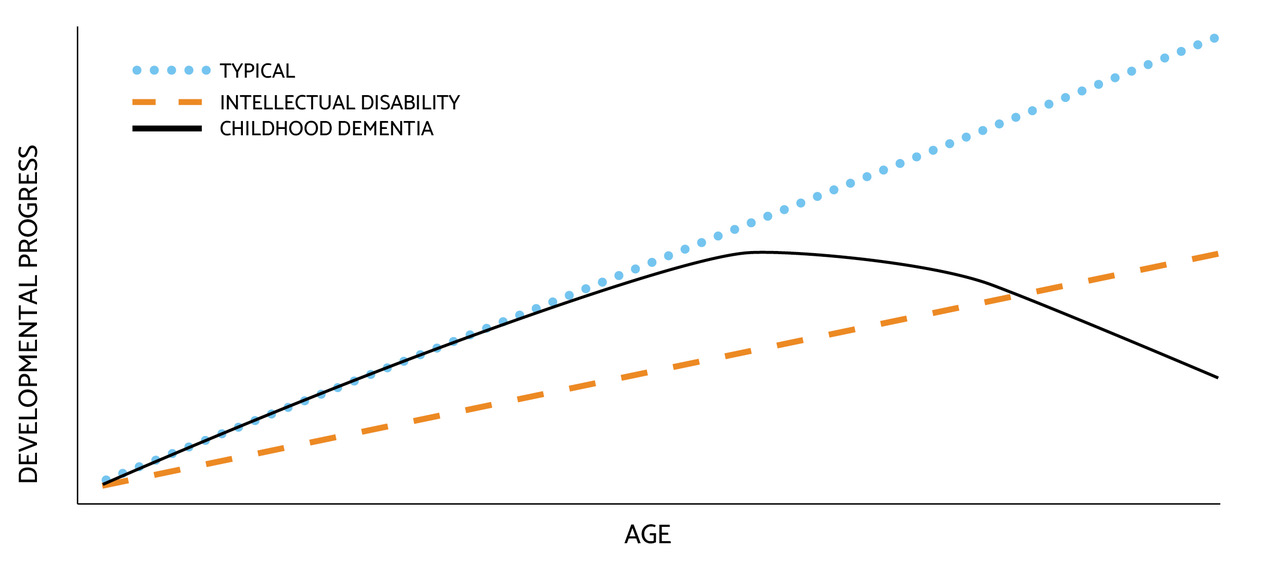
The trajectory of childhood dementia classically proceeds in line with normal development for a long or short interval then decelerates and ultimately regresses (adapted from Haugen et al., 2019).
Is this resource helpful?
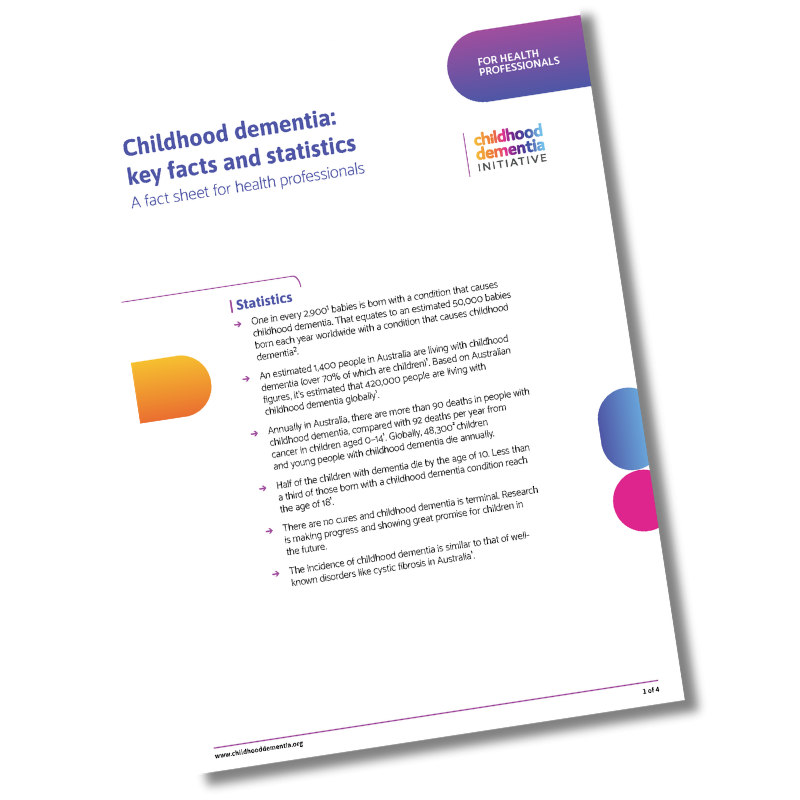
Childhood Dementia: key facts and statistics
Childhood dementia affects an estimated 1 in every 2,900 babies born, with around 50,000 babies born worldwide each year with a condition that causes it. Half of the children diagnosed die by the age of 10. Caused by more than 145 genetic conditions, it involves the progressive loss of previously acquired skills such as walking, talking and thinking.
This fact sheet for health professionals covers the prevalence and impact of childhood dementia, its clinical definition, causes, common symptoms and prognosis, to support your understanding of the conditions affecting the children and families you work with.
Video series: Health professionals' perspective
EPISODE 1
Your role and hope: reflections from Professor Kenneth Nunn and Sam, dad to Caleb
In the absence of cures, families and professionals are tasked with ensuring the best possible quality of life for their children. This video speaks to professionals’ roles and the opportunities to provide hope.
EPISODE 2
Care, support & referrals for children with dementia: clinicians’ advice
Clinicians’ advice on providing care and support for children with dementia, including early diagnosis, referrals and support for multidisciplinary care, palliative care, and clinical trials.
EPISODE 3
Forever stories of families impacted by childhood dementia
Insights from Dr Leigh Donovan, Consultant in palliative care, loss, grief and bereavement (Thanatology). Ali, mother to Eddie, shares an important memory enabled by a nurse during her son’s care.
EPISODE 4
Paediatric palliative care for children with dementia
In the absence of cures, families and professionals are tasked with ensuring the best possible quality of life for their children. This video speaks to professionals’ roles and the opportunities to provide hope.
EPISODE 5
Diagnosing childhood dementia & advice on diagnosis delivery
Clinicians share the signs and symptoms of childhood dementia, the process of finding a diagnosis and how they plan to sensitively deliver a diagnosis of a condition that causes childhood dementia.
EPISODE 6
Using the term 'childhood dementia'
Health professionals share the benefits of using the term ‘childhood dementia’ and their reflections and advice on the use of the term. Childhood dementia is an umbrella term used to describe a range of genetic conditions.
“Realise that these children are often at the very extreme end of what you might treat or see on a day-to-day basis.”
Video series: Parents and carers perspective
EPISODE 1
We need respect, care, kindness and hope
Parents of children with dementia share the value of being treated with respect, care and kindness by healthcare professionals.
EPISODE 2
Please understand we are the experts on our children
Parents of children with dementia share the value of health professionals understanding they are the experts on their children.
EPISODE 3
Please do some research about childhood dementia
Parents of children with dementia share the value of health professionals doing some research to know more about childhood dementia.
EPISODE 4
Use your knowledge of my child’s dementia
Parents of children with dementia share the value of health professionals using their knowledge to give children the care and support they need.
EPISODE 5
Recognise the impact of childhood dementia on the whole family
Parents of children with dementia share the value of health professionals recognising the impact of childhood dementia on the whole family.

5 requests from families: a guide on how to work together
This information sheet summarises for you the 5 major themes collected during a series of focus groups and interviews with parents and carers. These focus groups were conducted in 2021 and 2022 to collect information on how health and care professionals can work with families.
Childhood Dementia Knowledgebase

The Childhood Dementia Knowledgebase is a relational database providing key statistics for each of the more than 145 conditions that cause childhood dementia. This includes incidence, prevalence, life expectancy, age of onset and diagnosis, genetic cause, and signs and symptoms. Designed as a public resource for clinicians and researchers, it supports the identification of conditions with shared symptoms or treatment approaches. This helps drive collaborative research across multiple conditions.
Join the Childhood Dementia Research Alliance
Connect with researchers and clinicians from around the world working to accelerate research into childhood dementia. Members receive the latest news and opportunities for collaboration, and help shape research priorities across this growing field. The page also features further resources, including webinars, publications, and reports on the latest developments in childhood dementia research.

Childhood Dementia Project Echo® Community of Practice
Join the online community of health, education, disability and care professionals sharing and building knowledge on optimal care for children with dementia.
A place for health, education, disability and other care professionals to connect with experts and learn together about care for children with dementia.
The Childhood Dementia Community of Practice is a free, supportive, educational platform. It is designed to connect you with subject-matter experts and other professionals to share knowledge and experience on caring for children with dementia.
Join the community that's creating change
Subscribe to our newsletter and join the growing community of health, social care and education professionals who are learning more and contributing to solutions. We will keep you up to date on emerging research and insights, the Community of Practice and how you can take part, information resources for professionals working with children and families, webinars, information sessions and in-service opportunities.