Information for disability workers and professionals
Here you will find information and resources for those working in the disability sector where you are supporting a child with childhood dementia. This includes allied health professionals, support coordinators, and disability support workers in home, community, or disability service settings.
These resources are designed to help you understand childhood dementia, adapt your approach as a child’s needs evolve, and work alongside families and other professionals to provide the best possible support.
For information relevant to all professionals, including what childhood dementia is, families’ lived experiences, and how to support and communicate with families, visit our Information for Professionals page.
Is this resource helpful?
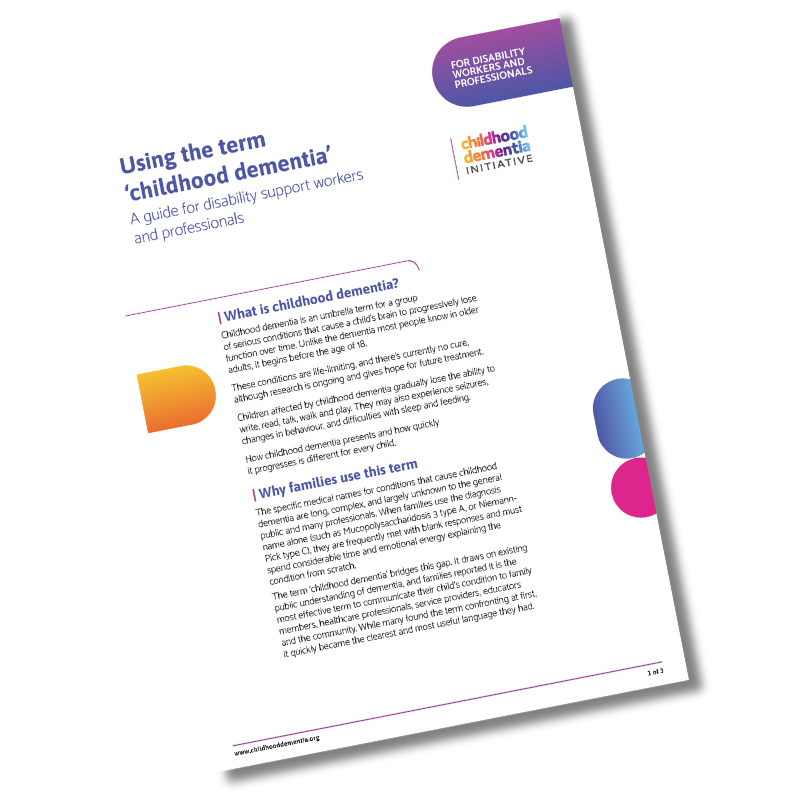
Using the term 'childhood dementia'
You may be supporting a child or young person diagnosed with a condition that causes childhood dementia. Their family may use that term to describe it.
Childhood dementia is an umbrella term for a group of serious, life-limiting conditions. These cause a child's brain to progressively lose function, beginning before the age of 18. Children affected gradually lose the ability to write, read, talk, walk and play. They may also experience seizures, changed behaviour, and difficulties with sleep and feeding. Presentation and progression differ for every child.
Families have found 'childhood dementia' the clearest way to communicate their child's condition to those in their care team and the wider community. While many found the term confronting at first, it quickly became the clearest and most useful language they had.
This guide shares more about why families use this term and how to use it respectfully.
“I just think that it makes people understand really what she’s going through. It’s just been the easiest way to tell her story.”
Parent, Childhood Dementia Initiative focus group
Working with a child with childhood dementia: a guide
This guide will help you understand childhood dementia and what it means for your work with a child and their family. It covers what you might see as the child’s needs change over time, what the family is going through, and what families have told us helps, and what doesn’t, from the people supporting them.
Two versions of this guide are available: one for disability professionals, such as support coordinators and allied health professionals and one for disability workers and support staff. Select the version that best matches your role.
Working with a child with childhood dementia:
A guide for disability professionals
Covers what childhood dementia is and what it means for your work, including how skills, goals and support approaches need to adapt as the condition progresses.
Working with a child with childhood dementia:
A guide for disability workers and support staff
A plain-language guide covering what to expect, what families are going through, and practical ways to help.
Childhood Dementia Project Echo® Community of Practice
Join the online community of health, education, disability and care professionals sharing and building knowledge on optimal care for children with dementia.
A place for health, education, disability and other care professionals to connect with experts and learn together about care for children with dementia.
The Childhood Dementia Community of Practice is a free, supportive, educational platform. It is designed to connect you with subject-matter experts and other professionals to share knowledge and experience on caring for children with dementia.
Join the community that's creating change
Subscribe to our newsletter and join the growing community of health, disability and education professionals who are learning more and contributing to solutions. We will keep you up to date on emerging research and insights, the Community of Practice and how you can take part, information resources for professionals working with children and families, webinars, information sessions and in-service opportunities.