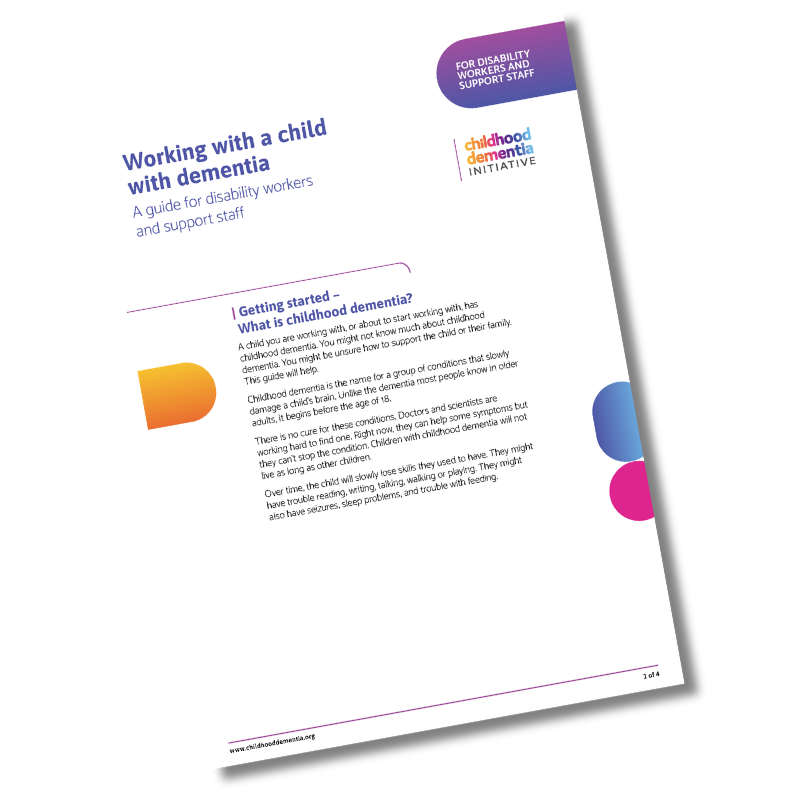
Working with a child with dementia
A guide for disability workers and support staff
Is this resource helpful?
Summary
This guide gives a clear, straightforward explanation of working with a child with dementia. This resource features:
Getting started - What is childhood dementia?
A child you are working with, or about to start working with, has childhood dementia. You might not know much about childhood dementia. You might be unsure how to support the child or their family. This guide will help.
Childhood dementia is the name for a group of conditions that slowly damage a child’s brain. Unlike the dementia most people know in older adults, it begins before the age of 18.
There is no cure for these conditions. Doctors and scientists are working hard to find one. Right now, they can help some symptoms but they can’t stop the condition. Children with childhood dementia will not live as long as other children.
Over time, the child will slowly lose skills they used to have. They might have trouble reading, writing, talking, walking, or playing. They might also have seizures, sleep problems, and trouble with feeding.
What you might see when you work with the child
Each child with dementia is different. Depending on the condition they have, their dementia may progress slowly or quickly. The skills the child has today might not be there in a few months.
You might see the child:
- Have trouble remembering things, learning, or paying attention
- Find it harder to say what they want, need, or if they’re in pain
- Find it harder to move, stay steady, or do everyday things
- Have changes in how they see, hear, eat, swallow, or go to the toilet
- Have seizures (with some conditions)
- Sleep badly or feel tired
- Seem different in their mood, behaviour, or how they get along with others
- Feel scared, worried, or upset, especially as things get harder for them
All of this is part of the condition.
What the family is going through
When parents are told their child has dementia, life changes for the whole family.
- Parents are doing many jobs at once. A child with dementia needs more care over time, not less. They are also very sad about what’s happening.
- Brothers and sisters can feel left out, confused or worried
- Brothers and sisters might help with caring at home
- Every day is busy. There are lots of appointments, forms, and changes to deal with
- You are working in the family’s home. This can be a help, but also a big change for parents
Sometimes more than one child in a family has childhood dementia. This is because most of these conditions are genetic, so brothers and sisters can have the same condition. When this happens, families have even more to deal with.
How you can support the child and family
Families have told us what works well, and what doesn’t. Here are some things that help, and some things that may not.
What helps
- Be kind. Listen properly. Make sure you’ve understood what the family said
- Do what you say you’ll do
- Trust the parents. They know their child best. They know how their child talks, what calms them, and what works
- Read the care plan before each shift. Don’t ask the family to tell you everything again
- Help the child keep doing what they can. Don’t push them to do things that are getting harder for them
- Ask how the family is going. A simple “how is everyone doing?” can mean a lot
- Turn up on time. Tell the family early if your shift will change. Don’t make them chase you
- Help parents feel they can trust you. Be calm. Show them you know what you’re doing. Parents want to be able to step away, knowing their child is safe with you
- Look after the child, and let the family get on with their day
What doesn’t help
- Making parents train you. Things like lifting and personal care are basic skills you bring with you, not something the family should have to teach you
- Making extra work for parents. Try to sort out small things yourself before asking.
- Skipping a shift without telling them. A missed shift can mean a parent can’t go to work or sleep
- Promising things you can’t do. Be honest. Many families have been let down before
- Pulling back when things get hard. The child’s needs will change. Keep showing up and doing your job well
Before your first shift
A bit of homework before you start will help a lot. Before you go to the family’s home for the first time:
- Read the care plan. Read anything else the family has shared with your workplace
- Bring some questions. You could ask: “What’s the best way to say hello to the child?” or “What would help me get to know your child?”
- Ask how the family likes to talk with workers. How do they want updates? How should you tell them if something is wrong?
- Check your shifts ahead of time. Tell the family early if anything will change
Working with the team
You may be one of many people helping this child. When you all work well together, the family gets better help and the child gets better care.
- Talk to the other support workers. Share what worked, what didn’t, and what has changed
- Write clear notes for the next worker so the family doesn’t have to say things again
- Tell your boss if you are worried. Don’t leave it to parents to sort out
The importance of hope
Families want you to see their child as a whole person, not just their condition.
Some ways to do this:
- Get to know what the child likes and doesn’t like
- Talk to the child, not just about them
- Notice good moments, like a smile, a laugh, or something they enjoyed today. Say something about it.
- Let parents guide you on what makes the child happy
“Despite the challenges, we're committed to giving our child the best possible life."
- Parent of a child with a childhood dementia condition
Looking after yourself
This work can be hard. You are not on your own.
- It’s OK to feel sad. Feeling sad, worried, or unsure is normal
- Talk to your boss after hard shifts
- Use the free service at work. Many workplaces have free counselling for staff. Ask your boss how to get it
Resources and support
| For more information | For families | Additional support |
|---|---|---|
| Childhood Dementia Initiative Visit our page for professionals |
Childhood Dementia Initiative Visit our page for families |
Beyond Blue: 1300 22 4636 Lifeline: 13 11 14 |
This guide is intended as general information about childhood dementia. For specific information about a student’s medical condition, please consult their family or a healthcare professional.
This resource is based on Childhood Dementia Matters 2: What families want health professionals and service providers to know (2022), and on insights shared by families in associated focus groups.