Communicating with families of children with dementia
A guide for support workers, teachers and professionals
Is this resource helpful?
Summary
This guide gives a clear, straightforward explanation of communicating with families of children with dementia. This resource features:
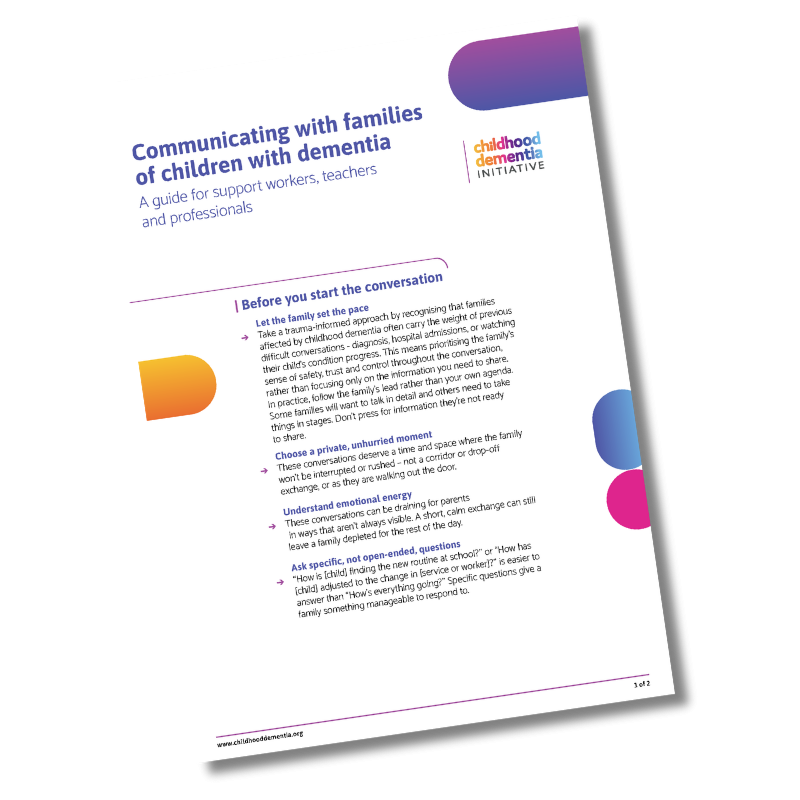
Before you start the conversation
Let the family set the pace
Take a trauma-informed approach by recognising that families affected by childhood dementia often carry the weight of previous difficult conversations. These may include diagnosis, hospital admissions, or watching their child’s condition progress. This means prioritising the family’s sense of safety, trust and control throughout the conversation, rather than focusing only on the information you need to share. In practice, follow the family’s lead rather than your own agenda. Some families will want to talk in detail and others need to take things in stages. Don’t press for information they’re not ready to share.
Choose a private, unhurried moment
These conversations deserve a time and space where the family won’t be interrupted or rushed: not a corridor or drop-off exchange, or as they are walking out the door.
Understand emotional energy
These conversations can be draining for parents in ways that aren’t always visible. A short, calm exchange can still leave a family depleted for the rest of the day.
Ask specific, not open-ended, questions
“How is [child] finding the new routine at school?” or “How has [child] adjusted to the change in [service or worker]?” is easier to answer than “How’s everything going?” Specific questions give a family something manageable to respond to.
What helps and what to avoid
| What helps | What to avoid |
|---|---|
|
|
If a family becomes upset or shuts down
That’s a normal response, not a sign you’ve done something wrong. Acknowledge it gently. For example: “I can see this is a lot, there’s no pressure to talk more now.” Then let them know you’re there when they’re ready.
Different ways families may want to communicate
- Some families may prefer written communication over a conversation, such as an email or a note, particularly for sensitive updates
- Parents may nominate a trusted support person to communicate on their behalf. Confirm early on who to direct updates or questions to, so they aren’t repeating themselves
- Sometimes parents will share something with you informally and unplanned, such as during an appointment, a home visit, or in passing conversation. Follow their lead in that moment rather than asking for more detail
- With parents’ consent, keep other staff or team members who interact with them briefed, so information isn’t repeated unnecessarily across different people
Resources and support
| For more information | For families | Additional support |
|---|---|---|
| Childhood Dementia Initiative Visit our page for professionals |
Childhood Dementia Initiative Visit our page for families |
Beyond Blue: 1300 22 4636 Lifeline: 13 11 14 |
This fact sheet summarises key points from Childhood Dementia Initiative’s guide, Having difficult conversations: a guide for parents, which was co-designed with parents of children with dementia.